
How to Choose the Best SEO Company: 10 Questions to Ask Before Hiring
Choosing the Best SEO Company starts with understanding your business goals and target audience.Search “best SEO company” and you’ll get thousands of agencies claiming to be exactly that. Nearly every one promises page-one rankings, more traffic, and more customers. The problem is that these claims all sound identical, and business owners without a technical background have almost no easy way to tell which agency is genuinely capable and which one is simply good at marketing itself.
This guide is meant to close that gap. Rather than another list of vague qualities to look for, it walks through the specific, practical questions worth asking before you hire anyone — and what the answers actually tell you.
Why Choosing the Right SEO Company Matters So Much
The Best SEO Company should provide a clear strategy instead of making unrealistic ranking promises. SEO isn’t a quick, low-stakes purchase. It’s typically a six-to-twelve-month commitment, both in terms of budget and in terms of the changes made to your website and content. Choosing poorly doesn’t just waste money — a bad agency using risky shortcuts can actively damage your site’s standing with Google, sometimes taking months to undo.
On the other hand, the best SEO company for your business isn’t necessarily the biggest or most expensive one. It’s the one whose approach, communication style, and track record genuinely fit what your business needs. That’s exactly why going in with the right questions matters more than going in with a fixed budget or a list of agency names.
Question 1: What Specific Strategies Will You Use?
Before hiring the Best SEO Company, ask about their experience with businesses similar to yours. This is the single most revealing question you can ask. A capable agency should be able to explain, in plain language, roughly what they plan to do — auditing your current site, researching keywords relevant to your industry, fixing technical issues, building out content, and earning quality backlinks.
Be cautious of vague answers like “we’ll get you to page one” without any explanation of how. Be even more cautious of anyone guaranteeing a specific ranking position or a specific timeline — no reputable agency can honestly promise exact rankings, since Google’s algorithm isn’t something any outside company controls.
Question 2: Can You Show Results From Similar Businesses?
A reliable Best SEO Company will explain its SEO process in simple and transparent language.Case studies and client examples, ideally from businesses in a comparable industry or of a similar size,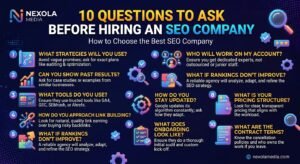 give you a realistic sense of what’s achievable. Ask specifically what the starting point looked like, what was done, and what changed over what time period.
If an agency can’t or won’t share any concrete examples, treat that as a meaningful gap, not just an inconvenience. A genuinely established agency should have at least a few stories they can point to, even if client confidentiality means some details are kept general.
Question 3: What Tools Do You Use for Tracking and Reporting?
The Best SEO Company should focus on long-term organic growth rather than quick ranking tricks.This question tells you two things at once: whether the agency invests in proper tools, and how transparent their reporting will actually be. Reputable agencies typically rely on a combination of Google Search Console, Google Analytics, and a paid research platform like SEMrush or Ahrefs.
Ask what a typical monthly report looks like, and if possible, ask to see a sample. You want reporting that shows real movement in rankings, traffic, and — ideally — actual business outcomes like calls or form submissions, not just vanity metrics dressed up to look impressive.
Question 4: How Do You Approach Link Building?
Link building is where a lot of risky, shortcut-driven practices tend to hide. Ask directly how the agency earns backlinks. When comparing SEO agencies, look at what the Best SEO Company actually includes in its monthly services.Answers involving guest posting on relevant, credible sites, digital PR, or content that naturally attracts links are good signs.
Answers that are vague, or that mention buying links in bulk from unrelated or low-quality sites, are a red flag. These tactics can trigger Google penalties that are difficult and slow to recover from, and any agency still relying on them either doesn’t understand current best practices or is prioritizing quick wins over your long-term interests.
Question 5: What Happens If Rankings Don’t Improve?
This question tests both honesty and accountability. A good agency should be comfortable explaining that SEO takes time, typically several months before meaningful movement, and should be able to describe what they’d actually do if progress stalls — revisiting the strategy, digging into what’s not working, adjusting the approach.
Be wary of agencies that either promise guaranteed results (which isn’t realistic) or that seem to have no real plan for what happens if the initial approach doesn’t pan out as expected.
Question 6: Who Will Actually Be Working on My Account?
Many agencies sell services through senior, experienced salespeople but hand off the actual execution to junior staff or, in some cases, outsource it entirely to third parties with no direct oversight. Ask specifically who will be doing the work, what their experience level is, and whether you’ll have a consistent point of contact throughout the engagement.A professional Best SEO Company should provide regular reports showing rankings, traffic, and important SEO improvements.
This matters more than it might seem — consistency in who understands your business and its history tends to produce noticeably better results than work that gets passed between different people with no continuity.
Question 7: How Do You Stay Updated With Google’s Algorithm Changes?
Google updates its algorithm constantly, and strategies that worked well a couple of years ago can be actively harmful today. An agency that takes this seriously should be able to speak knowledgeably about recent changes and how their approach has adapted over time.Reviews and previous results can help you determine whether an agency is genuinely the Best SEO Company for your needs.
Vague or outdated answers — relying heavily on tactics that were considered best practice years ago, like aggressive keyword density or purely quantity-focused link building — suggest the agency hasn’t kept pace with how search actually works now.
Question 8: Can You Explain Your Pricing Structure Clearly?
SEO pricing varies enormously, and there’s no single “correct” number, but a trustworthy agency should be able to clearly explain what’s included at a given price point, and why. Be cautious of pricing that seems dramatically lower than everyone else you’ve spoken to — this often means shortcuts are being taken somewhere, whether in the quality of work, the tools used, or the level of attention your account actually gets.The right Best SEO Company will adjust its strategy as your website and search competition change.
Equally, higher pricing alone doesn’t guarantee better results. What matters is whether the scope, deliverables, and reporting genuinely match what you’re paying for.
Question 9: What Does the Onboarding Process Look Like?
A structured onboarding process — an initial audit, a discussion of your goals and competitors, a clear plan for the first few months — signals that an agency treats each client as a distinct situation requiring its own strategy, rather than running every client through an identical template.
Agencies that skip this step, or that seem to already have a fixed plan before even reviewing your website, are more likely delivering a generic package than a strategy actually built around your business.
Question 10: What Are the Terms If I Want to Leave?
Before signing anything, understand the contract length, cancellation terms, and — importantly — who owns the work once the relationship ends. Some agencies build content, backlinks, and optimizations under terms that make it difficult to fully benefit from that work if you leave, or that lock you into unusually long commitments.
A confident, reputable agency should be comfortable with reasonable flexibility, since they should expect to retain your business through results rather than through a rigid contract.Ultimately, the Best SEO Company is the one that offers the right combination of expertise, transparency, strategy, and value.
Red Flags Worth Watching For Beyond These Questions
A few warning signs are worth flagging even outside the direct answers to these ten questions.
Guaranteed rankings for specific keywords, especially within a short timeframe, is one of the clearest signs of an agency either overselling its capabilities or planning to use risky tactics to force short-term movement.
Unusually low pricing compared to the rest of the market often means the quality of work, or the amount of genuine attention your account gets, is being cut to make the numbers work.
Pressure to sign quickly, without time to review a contract or compare other options, isn’t typical of agencies confident in their own value.
Lack of transparency about specific tactics, especially around link building, is one of the most reliable indicators that something happening behind the scenes wouldn’t hold up well under scrutiny.
No clear reporting cadence, or reporting that consists mostly of screenshots without real explanation, often signals that there isn’t much substance behind the numbers being shown.
What Good Communication Looks Like
Beyond the technical side, the working relationship itself matters more than many business owners initially expect. A good agency explains what it’s doing and why, in language you can actually follow, rather than burying decisions in jargon that makes it hard to evaluate whether the work is genuinely good.
Regular check-ins, a willingness to answer questions without becoming defensive, and a clear escalation path if something isn’t working are all signs of an agency that treats the relationship as a genuine partnership rather than a one-way service delivery.
Weighing Cost Against Value
It’s tempting to treat price as the primary decision factor, but cost alone tells you very little about what you’re actually getting. A far more useful comparison looks at what’s included at each price point — how much research goes into the strategy, how much content is produced, how thorough the technical work is, and how detailed the reporting will be.
In many cases, a mid-priced agency with a clear, well-explained process delivers better long-term value than either the cheapest option, which often cuts corners, or the most expensive one, where a large portion of the cost may go toward overhead and brand reputation rather than the actual work done on your account. The goal isn’t to find the cheapest or the most prestigious name — it’s to find the clearest match between what you’re paying for and what you’re genuinely getting in return.
Why Local Agencies Sometimes Have an Edge
For businesses relying heavily on local customers, an agency with genuine local market knowledge — understanding how people in your specific city or region search, what local competition looks like, and how local SEO factors like Google Business Profile and citations actually work — often outperforms a larger, more generic national agency with no particular local expertise.
This isn’t a hard rule, but it’s worth weighing alongside the ten questions above, particularly if a large share of your customers come from a specific city or region rather than nationally or internationally. A local agency is also more likely to already understand the competitive landscape you’re operating in, which can shorten the learning curve at the start of the engagement considerably.
Comparing In-House SEO, Freelancers, and Agencies
Before narrowing down to a specific company, it’s worth stepping back and considering whether an agency is even the right structure for your situation, compared to the alternatives.
Hiring in-house means bringing an SEO specialist onto your own team, full-time. This tends to make sense for larger businesses with enough ongoing work to justify a dedicated role, and offers the benefit of someone deeply embedded in your business and its goals. The downside is cost, and the risk of relying on a single person’s skill set rather than a broader team with varied expertise.
Working with a freelancer can be a good fit for smaller, well-defined projects — a one-time audit, a specific technical fix, or ongoing content work. Freelancers are often more affordable and flexible, but you take on more responsibility for coordinating the overall strategy yourself, since a single freelancer rarely covers every specialty SEO touches.
Hiring an agency generally makes sense when the work spans multiple areas — technical fixes, content, local SEO, link building — since agencies typically have team members covering different specialties, along with established processes and reporting systems already in place. This tends to be the right fit for most small and mid-sized businesses looking for a comprehensive, ongoing strategy without building an internal team from scratch.
None of these options is universally “best” — the right choice depends on your budget, how much ongoing work you genuinely have, and how much strategic oversight you’re able to provide yourself.
How to Interpret an Agency’s Initial Proposal
Once you’ve narrowed down a shortlist and received actual proposals, a few things are worth reading closely rather than skimming past.
Look at how specific the proposed strategy is. A proposal that references your actual website, your actual competitors, and your specific industry shows real effort was put into understanding your situation. A proposal that reads like it could apply to almost any business is a sign the agency may not be doing much genuine customization.
Check whether the timeline feels realistic. Proposals promising significant ranking improvements within a month or two for competitive keywords should raise questions, since this generally isn’t achievable through legitimate methods, regardless of budget.
Notice how deliverables are described. Vague line items like “SEO optimization” or “content work” without further detail make it hard to know what you’re actually paying for. Clearer proposals break down roughly how many pieces of content, what kind of technical work, and what reporting cadence to expect.
Pay attention to how questions are answered during the proposal stage. If you ask a clarifying question and get a clear, specific answer, that’s a good sign of how communication will likely go once you’re a client. Vague or evasive answers at this early stage tend to become a bigger problem once you’re locked into a contract.
Setting Realistic Expectations From the Start
Even after choosing a strong agency, results depend partly on expectations being set correctly from day one. SEO is not a switch that gets flipped — it’s closer to compound growth, where early months often show more foundational work than visible movement, and later months show the accumulated benefit of that work.
Businesses that go in expecting immediate, dramatic changes tend to feel disappointed even when an agency is doing genuinely good work, simply because the timeline doesn’t match reality. Businesses that understand the process tend to have a much smoother, more productive relationship with whichever agency they choose, and are better positioned to judge performance fairly rather than reacting to short-term fluctuations that are a normal part of how search rankings move.
Common Questions
How long should I commit to an SEO agency before judging results? Most reputable agencies recommend evaluating meaningful progress after three to six months, since that’s typically when early technical and content work starts translating into visible ranking movement. Judging results after just a few weeks rarely gives an accurate picture either way.
Is it a bad sign if an agency can’t guarantee specific rankings? No — it’s actually the opposite. No one fully controls Google’s algorithm, so any agency guaranteeing a specific ranking position is either overpromising or planning to use tactics that risk a future penalty.
Should I choose an agency based purely on client reviews? Reviews are useful context but shouldn’t be the only factor. Ask specifically what those clients’ situations were and what results actually looked like, rather than relying on star ratings alone, which can be easy to manipulate and don’t tell you much about fit for your specific business.
Is it worth hiring a freelancer instead of an agency? It depends on the scope of work needed. A skilled freelancer can be a good fit for smaller, more focused projects, while an agency often makes more sense when the work spans multiple specialties — technical fixes, content, link building, and local SEO — since few individuals are genuinely strong across all of them.
What’s a reasonable first step before signing with anyone? Ask for a free or low-cost initial audit of your current site. How thorough, specific, and honest that audit is — rather than how impressive the sales pitch sounds — often tells you more about the agency than anything else in the process.
How many agencies should I actually compare before deciding? Three to five conversations is usually enough to get a realistic sense of the range in approach, pricing, and communication style without dragging the process out too long. Comparing too few risks missing a much better fit, while comparing too many tends to create decision fatigue without meaningfully improving the outcome.
Does a bigger, more well-known agency automatically mean better results? Not necessarily. Larger agencies often bring more resources and broader experience, but they can also mean less individual attention per client and more staff turnover on your account. A smaller, more focused agency with a strong track record in your industry can sometimes deliver more consistent, attentive results than a larger name.
Trusting Your Own Judgment Alongside the Checklist
Questions and red flags give you a structured way to compare agencies, but it’s also worth trusting your own read of the relationship itself. Notice how an agency makes you feel during the sales process — rushed and pressured, or genuinely listened to and understood. Notice whether they seem more interested in closing a deal quickly or in actually understanding whether they’re a good fit for your specific situation.
These softer signals don’t replace the concrete questions covered above, but they often align closely with how the actual working relationship plays out once a contract is signed. An agency that takes the time to understand your business properly during the sales conversation is far more likely to bring that same care into the actual work.
Bringing It Together
Finding the best SEO company for your business isn’t about finding the agency with the biggest promises — it’s about finding one whose strategy, communication, and track record genuinely hold up under a few direct, specific questions. Agencies confident in their own work tend to welcome these questions rather than deflect them, and that willingness to be transparent is often one of the most reliable signals available before you ever sign a contract.
Take the time to ask these ten questions of any agency you’re seriously considering, compare the answers honestly, and choose the one that earns your trust through clarity rather than through the size of its promises. The right choice, made carefully at the start, tends to save far more time, money, and frustration than rushing into a decision based on price or a persuasive sales pitch alone.
Understand Your Business Goals Before Hiring an SEO Company
Before choosing the Best SEO Company, the first step is to understand your own business goals. Every business has different needs, so the right SEO strategy depends on what you want to achieve. Some businesses want more website traffic, while others want more phone calls, leads, online sales, or local customers.
A Best SEO Company should take the time to understand your business, target audience, products, services, and competitors before creating an SEO strategy. Instead of using the same approach for every client, a professional SEO company should develop a strategy based on your specific goals.
For example, a local business in Noida may want to appear in Google searches such as “SEO company near me” or “digital marketing agency in Noida.” An e-commerce business may focus more on product keywords and online sales. Understanding these differences helps you choose an SEO partner that can work according to your business requirements.
Before hiring an agency, clearly define what you expect from SEO. Once your goals are clear, it becomes much easier to compare different SEO agencies and identify the Best SEO Company for your business.