Google Ads Keyword Match Types Explained
Google Ads keyword match types help advertisers control how closely a user’s search needs to match a keyword before an ad can be shown.
Choosing the right match type can help businesses reach relevant customers, control advertising costs, and avoid unnecessary clicks.
What Are Keyword Match Types?
Keyword match types are settings in Google Ads that determine which search queries can trigger your advertisement.
For example, if your keyword is digital marketing agency, different match types can make your ad appear for different types of searches.
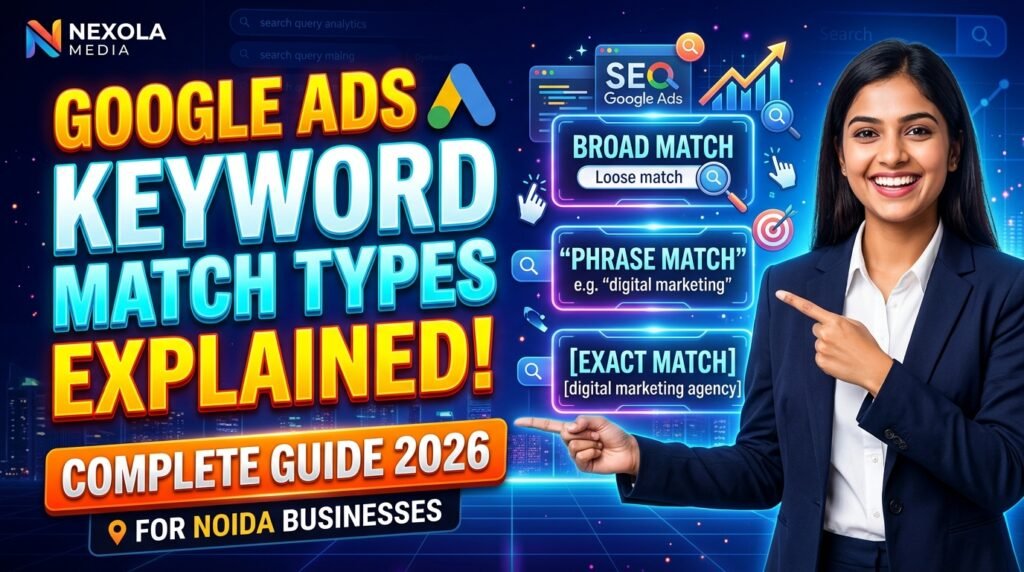
Google Ads mainly uses three keyword match types:
- Broad Match
- Phrase Match
- Exact Match
1. Broad Match
Broad Match gives Google Ads the most flexibility to find relevant searches.
Example Keyword:
digital marketing agency
Your ad may be eligible to appear for searches related to the meaning of your keyword, such as:
- digital marketing services
- online marketing agency
- digital advertising company
- marketing agency near me
Best For:
Broad Match can be useful when you want to reach a wider audience and discover new relevant searches.
Important:
Because Broad Match can reach a wider range of searches, you should regularly check your Search Terms Report and add irrelevant searches as negative keywords when necessary.
2. Phrase Match
Phrase Match provides more control than Broad Match while still allowing your ad to reach variations of the keyword’s meaning.
Example Keyword:
“digital marketing agency”
Your ad may appear for searches such as:
- best digital marketing agency
- digital marketing agency near me
- affordable digital marketing agency
- digital marketing agency for small business
Phrase Match is useful when you want to reach people searching for your main keyword or closely related searches.
3. Exact Match
Exact Match provides the most control over targeting among the three match types.
Example Keyword:
[digital marketing agency]
Your ad can be eligible for searches that have the same meaning or intent as your keyword, including close variations.
For example:
- digital marketing agency
- digital marketing agencies
- agency for digital marketing
Best For:
Exact Match can be useful when you want more precise targeting and want to focus your budget on highly relevant searches.
Broad Match vs Phrase Match vs Exact Match
| Match Type | Control | Reach | Best For |
|---|---|---|---|
| Broad Match | Low | High | Wider reach |
| Phrase Match | Medium | Medium | Balanced targeting |
| Exact Match | High | Lower | More precise targeting |
Which Keyword Match Type Should You Use?
There is no single match type that is best for every campaign.
Use Broad Match when:
You want to discover new searches and reach a broader audience.
Use Phrase Match when:
You want a balance between reach and relevance.
Use Exact Match when:
You want to focus on highly relevant searches and have greater control over targeting.
A good Google Ads campaign should also monitor search terms regularly and use negative keywords to reduce irrelevant traffic.
What Are Negative Keywords?
Negative keywords tell Google Ads which searches you do not want your ads to appear for.
For example, if you provide paid digital marketing services but do not offer free services, you might add free as a negative keyword.
This can help reduce irrelevant clicks and protect your advertising budget.
Tips for Using Keyword Match Types
- Choose keywords that are relevant to your products or services.
- Start with keywords that match your target customer’s search intent.
- Monitor your Search Terms Report regularly.
- Add irrelevant searches as negative keywords.
- Track CTR, conversions, and conversion rate.
- Test different match types and improve your campaign based on performance.
Conclusion
Google Ads keyword match types help advertisers control how their ads respond to user searches.
Broad Match helps increase reach, Phrase Match provides a balance between reach and relevance, and Exact Match offers greater control over targeting.
Understanding these match types is an important step toward creating more relevant Google Ads campaigns and using your advertising budget effectively.
Nexola Media — Helping Businesses Grow in the Digital World.